
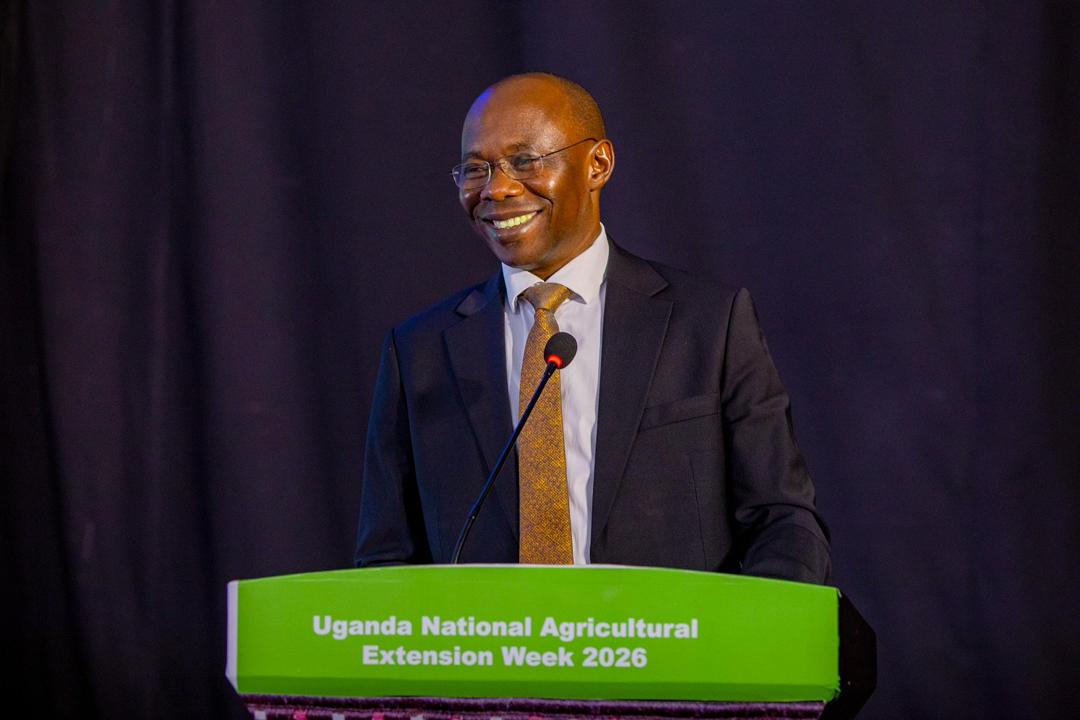
Uganda’s agriculture sector has received a renewed policy focus with the opening of the National Agricultural Extension Week 2026, where the Ministry of Agriculture, Animal Industry and Fisheries (MAAIF) announced plans to introduce a National Agricultural Extension Services Law aimed at transforming service delivery and boosting productivity.
Speaking at the event, Henry Nakalet Opolot, Commissioner for Agriculture Extension Services and Skills Management, outlined ambitious long-term targets tied to the proposed reforms.
“In the next 50 years, we aim to raise commodity productivity by at least 50% and create no less than 50,000 jobs annually through agro-processing industries and factories,” he said.
Opolot noted that the reforms are aligned with Uganda’s National Development Plan V, positioning agriculture as a central driver of economic growth. Key targets include increasing national food and nutrition security from 71% to 85% and raising agricultural financing from 11% to 15%.
“Agriculture is not just a livelihood sector—it is central to industrialization and national development,” he emphasized.
Officials said the proposed law builds on earlier reforms, including the integration of extension services under programmes such as National Agricultural Advisory Services, which were later mainstreamed into MAAIF structures.
Sector experts welcomed the move but called for stronger financial backing and structural improvements. Carl Erik, Executive Director of the Global Forum for Rural Advisory Services, stressed the importance of sustained investment in extension systems to improve farmer productivity and livelihoods.
Meanwhile, Richard Miiro, Chairperson of the Uganda Forum for Agricultural Advisory Services, called for more structured farming systems and better coordination between advisory bodies and farmers to enhance efficiency across the value chain.
Experts also highlighted the potential of a strengthened extension system to attract young people into agriculture by positioning it as a viable and profitable enterprise.
As consultations continue, the proposed law is expected to play a critical role in reshaping Uganda’s agricultural sector and advancing inclusive economic growth.
